
.svg)

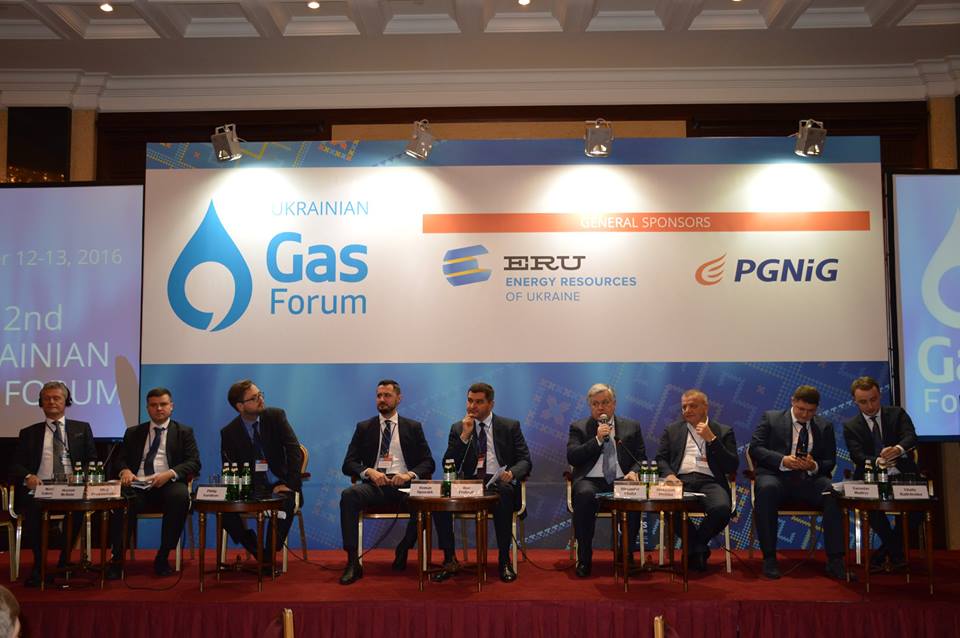
The Association of Gas Producers of Ukraine has participated in the Second Ukrainian Gas Forum. The Association's executive director, Roman Opimakh, talked about new investments and technology. The Association has presented forecasted production for next year, as well as analysis of why under current tax system the industry is missing its chance for update and perspective for growth of domestic production.
Roman Opimakh: "Taxes are one of the most important parts of the favorable investing climate, needed to increase natural gas production by 35% by 2020. Today, the level of taxes does not stimulate investors to take on the risks. Under current world gas prices and royalties of 29/14% depending on the well depth (above/below 5,000 m), developing new wells is not economically viable.
The industry argues for decreasing taxes to the average European level, setting the stimulating royalty on new investments starting in 2017 at 12%, and creating a motivation for local communities to collaborate with the oil and gas upstream companies through decentralization of royalty. Such decentralization is envisioned in the draft law #3038.
Forecasted production until the end of 2016: inert growth of production at a rate lower than 10%. In 2017 commercial production tends to stagnate, growth will stop for private companies in case the status quo scenario remains.
Philip Vorobyov, responsible for strategy at the British JKX Oil & Gas: "We believe in the Government's program of increasing production to 27 bcm by 2020 and achieving energy independence, and we will help Ukraine. However, Ukraine has to bring technology to the industry, which is currently way behind. The unattractive fiscal regime is in the way, it is not competitive in the world. Gas prices are falling, taxes remain unchanged. Take a note of the commercial producers, since small investors are the driving force of the gas production market. They are the ones with great capacities to build the industry. JKX has initiated a technical plan of Rudenkivske field development. According to the plan we must drill a lot of new wells over the course of the next 5 years. In total, such drilling will cost approximately $600m. To perform the plan, we have to be certain that the fiscal regime will remain favorable for new investments."
EU Ambassador to Ukraine, Hugues Mingarelli, reported: "Natural gas is the milestone of energy cooperation between UKraine and the EU. After 10 years of collaboration between the European Commission and Ukraine on the basis of energy Memorandum, we have arrived at a need to review the document and and intensify cooperation. Today, we congratulate Ukraine on passing important Laws on National Energy and Utilities Regulatory Commission, and the Law on natural gas market. However, an investor must be certain that the reforms will continue, we need a clear signal! In particular, continued work on creating an independent system of operators, non-discriminatory access to the network, open the sector of gas distribution, make it open to the consumer, create a system of protecting consumers not protected from the risen prices, implement the energy efficiency policy. The three-way negotiations Ukraine-EU-Russia should be resumed, and vice-president of the European Commission for the Energy Union issues, Mr. Marosh Shefchovich, is ready to participate. The EU continues to perceive Ukraine as a transit country, we depend upon you, and we are hoping for collaboration in this area!"
Minister of Energy and Coal Industry of Ukraine, Ihor Nasalyk in his speech has highlighted the importance of the proposals, developed by the participants of the Forum, related to the issues, which obstruct the natural gas market work. The Law has been passed, but it does not work.
Mr. Nasalyk also reminded about the issue of the safety natural gas stock: "The approved Law, which decreases the obligations of the companies on safety stock to 10%. My point of view is that this is the alternative option of filling the storages by freezing the funds of other participants of the market, the investors."
Nasalyk also assured the participants that "Ukraine is ready for the heating season. A balance has been developed with the main assumption of (minus 25°C), reserves of coal are 1,736 thousand tons, 11 nuclear power blocks are operating."
During the second part of the Forum external transit relations of Ukraine were discussed. Olga Belkova, deputy Head of the Energy Industry, Nuclear Policy and Security Committee, during the discussion with Trailstone, Eustream, PGNIG representatives has noted: "I will fight against any transits that go around Ukraine. We are ready to mutually work on the transit strategy and competitive tariffs, but come to us. Find Europe in Ukraine. Take mutual responsibility for the strategy of transit through our country! Ukraine is at the same time also focusing on increasing domestic natural gas production. It is the mission that is important in order to increase our energy independency, and we invite you to invest in production technologies!
Key figures in the International Energy Agency's (IEA) representative, Thea Khitarishvili, were the forecasted increase in natural gas imports to Europe by 50 mcm by 2020, and by 60 mcm by 2025. Partly, increased consumption will be satisfied by LNG. Low gas prices will also facilitate coverage of those volumes. Expectations and forecasts regarding Ukraine: increased natural gas production by small and medium business in the industry, easing of the fiscal regime and access to the development of fields. We expect UkrGasVydobuvannya to hold tenders on deep drilling of wells and guarantees for the service providers."
Mikhail Krutikhin from RusEnergy has told about the worldwide gas prices "war". "Today the US is selling gas at prices lower than the cost of production. Gazprom has set a break-even tariff for the company at $5.25 per 1,000 cubic meters, but today is selling at $4.16 per 1,000 cubic meters."